Why proper training matters
Module 1 — Introduction to Professional Phlebotomy
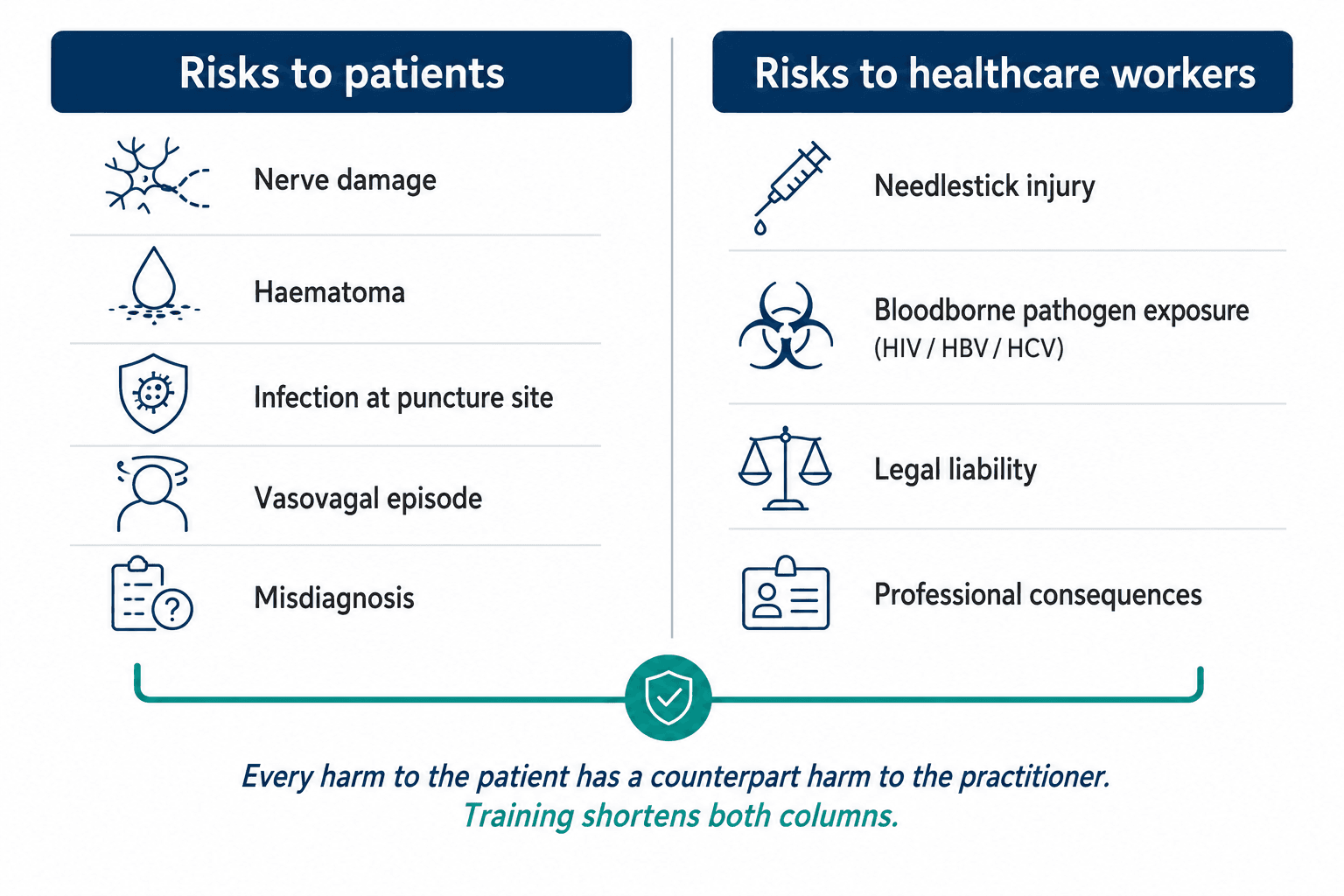
Risks to patients
- Nerve damage
- Excessive bleeding or haematoma
- Infection at puncture site
- Fainting (vasovagal reactions)
- Inaccurate test results leading to misdiagnosis
Risks to healthcare workers
- Needlestick injuries
- Exposure to bloodborne pathogens (HIV, Hepatitis B/C)
- Legal liability
- Professional consequences
Of the bloodborne pathogens above, only Hepatitis B currently has a widely-used vaccine in routine clinical use. WHO recommends that healthcare workers receive hepatitis B vaccination before assuming duties that include potential exposure to blood and body fluids. There is no equivalent vaccine in routine use for HIV or hepatitis C, which is why the procedural controls — single-use sharps, immediate disposal, hand hygiene — carry the safety load for those two.
What the evidence shows
WHO has measured the risks of phlebotomy in concrete terms. A handful of figures worth carrying with you as you train:
- Bacterial transmission through donated packed red cells: between 1 per 100,000 and 1 per 1,000,000 units. Small in relative terms, but at the scale of a national blood supply it is non-zero, and the controls that keep it small live in technique and skin antisepsis.
- Tourniquet contamination with MRSA: up to 25% of tourniquets sampled in studies, mostly through lapses in hand hygiene or reuse between patients. Hand hygiene and tourniquet management — single-use where available, decontamination where reusable — are the controls.
- Bruising and haematoma at the puncture site in blood donors: 12.3%. Most cases are minor, but the rate is a sensitive marker of technique; services with stronger training and supervision consistently report lower numbers.
- Sample contamination by practitioner group: laboratory staff and members of dedicated phlebotomy teams achieve lower contamination rates than physicians, general nursing staff, or rotating medical students, even on the same baseline training. The likely driver is volume and focus — repeated, focused practice produces tighter technique than occasional draws between other duties.
The point of these numbers is not the numbers themselves; it is that what looks like a routine procedure has measurable failure modes, and the difference between safe and unsafe practice is often the disciplined repetition of small things.